Investigative report reveals the use of UN and humanitarian flights to slip sensitive cargo into Sanaa airport Investigative report reveals the use of UN and humanitarian flights to slip sensitive cargo into Sanaa airport
Hot Issues
September 23, 2026 - 11:11 PM Investigative report reveals the use of UN and humanitarian flights to slip sensitive cargo into Sanaa airport
An investigative report published by the "FraudWiki" platform, prepared by Dr. Abdulqader Al-Kharraz, revealed what he described as "complex penetrations" of Yemeni airspace, which he said were used to slip sensitive flights and cargo into Sanaa airport under the control of the Houthi militia, coinciding with movements of aircraft belonging to the United Nations and the "Doctors Without Borders" organization. According to the report, the Kenyan cargo aircraft Boeing 727-2Q9(Adv)(F), registered under the code 5Y-GMA and operated by the Kenyan company Safe Air, carried out a flight from Nairobi to Sanaa without registering an official destination on tracking systems during parts of its route, while turning off the transponder, before monitoring teams documented its arrival at Sanaa airport. The Nairobi–Sanaa flight and signal concealing According to the chronological sequence in the report, the aircraft took off from Nairobi on the morning of September 22, and after performing maneuvers within Kenyan airspace, it returned to the airport before taking off again northward, without an official destination appearing for it on tracking systems. At 09:15, the aircraft's signal appeared for several minutes over Yemeni territorial waters near Aden airspace, coinciding with the takeoff of a UN aircraft carrying the callsign UNO132H from Djibouti, before the signal disappeared again at 09:17 and continued until 09:35, according to the report. The report said that the aircraft continued its penetration toward Sanaa without appearing on tracking systems, while in the same area the UN aircraft UNO132H and the "Doctors Without Borders" aircraft with the code 3BNBZ appeared. At 09:53, the report said that field monitoring teams documented via photography the arrival of the Kenyan aircraft and its landing at Sanaa airport, before it took off again at 10:35 heading south while continuing to conceal its radar signal. It added that it appeared again at 11:10 over territorial waters near Aden at the same point where it disappeared in the morning, before heading toward Djibouti, and then turned off its signal at 11:18 while flying at low altitude, according to tracking data cited by the report. According to the report, the signal appeared again at 12:35 after departing Djibouti airport, before being turned off later during its flight to Nairobi, where the aircraft returned to Kenya. Parallel movements of UN and humanitarian aircraft The report linked this flight to the movements of two other aircraft, one belonging to "Doctors Without Borders" carrying the code 3BNBZ, and the other a UN aircraft carrying the callsign UNO132H. It said that the "Doctors Without Borders" aircraft took off from Djibouti without a specified destination and did not land in Aden during its flight to Sanaa, before heading directly to Sanaa airport, pointing out that the flight, according to the report, was not listed on the approved UN flight schedule for September 2026. It added that it landed in Aden for about 40 minutes during the return flight from Sanaa, before departing toward Djibouti at 12:35. As for the UN aircraft UNO132H, the report said it deviated from its scheduled route (Djibouti – Aden – Riyadh – Seiyun – Aden – Djibouti), as after landing in Aden it headed to Mukalla, before returning to Aden and then departing toward Djibouti. According to the report, Sanaa airport witnessed the arrival of two aircraft on that day: one large cargo aircraft and the other medium-sized. The report suggests a sensitive nature of the cargo In its analysis of the data, the report suggested that the Kenyan aircraft may have carried cargo of a sensitive nature—military or technical—based on what it described as the direct, covert route from Nairobi to Sanaa and bypassing inspection checkpoints. It also considered that the aircraft's stop in Djibouti during the return flight may have been a diversionary measure suggesting the flight underwent routine procedures, after completing the arrival and unloading operation in Sanaa. The report linked the timing of the movements of the Kenyan aircraft with the two United Nations and "Doctors Without Borders" aircraft, considering that the density of air traffic during the period extending roughly between 09:15 and 09:32 may have contributed to distracting aerial surveillance and covering for the movement of the Kenyan aircraft. "The Parallel Air Channel" and previous incidents The report linked the September 22 incident to what it described as a previous series of airspace violations that it says it documented during August and September 2026, pointing to a recurring pattern of turning off transponders over the Gulf of Aden and before entering Sanaa airspace. It also spoke of the existence of "two schedules" for humanitarian flights: one announced to official authorities and media, and the other an operational, closed one, alleging that some flights carry out routes on the ground that do not match the announced schedules. The report says that the continued arrival of flights at Sanaa airport directly and without undergoing routine inspection procedures raises questions about the extent of compliance with monitoring mechanisms and resolutions banning arms transfers to Yemen. Linking the aircraft to the July 13 incident The report indicated that the same Kenyan aircraft 5Y-GMA had previously been spotted on July 13, 2026, during an incident linked to the entry of the suspicious Iranian aircraft into Yemeni airspace. According to the report, the Kenyan aircraft belonging to "Safe Air" arrived at Sanaa airport at 09:10 and left at 10:07, before an aircraft belonging to the International Committee of the Red Cross landed at the airport, where the Houthi militia later announced "impounding it" in Sanaa. The report believes that the concurrent presence of the two aircraft may have provided logistical cover and field pressure in light of the warnings that were in place at that time regarding air traffic, while the Iranian aircraft attempted to enter Yemeni airspace and land in Sanaa before changing its route and landing at Hodeidah airport. The author of the report concludes that the repeated use of the same Kenyan aircraft in the July 13 incident and the September 22 incident raises, from his perspective, suspicion of the existence of a coordinated pattern, describing it as possibly playing a logistical role in establishing what he called a "parallel air channel" that uses radar evasion or the density of humanitarian flights to facilitate aerial movements linked to the Houthi militia. Demands for opening an investigation The report demanded that the Yemeni government, the Coalition, and international bodies concerned with air navigation open an investigation into the Kenyan aircraft's route, and review radar surveillance data and video recordings that it said document its landing at Sanaa airport. It also called for an official inquiry with the bodies concerned with humanitarian operations regarding the reasons why the "Doctors Without Borders" aircraft 3BNBZ did not land in Aden during its flight to Sanaa, and why the flight was not included in the approved flight schedule for September. It also called for updating the archive of what it called the "Parallel Air Channel file" and adding the landing recordings and radar data for the September 22 flight to its investigative dossier in preparation for issuing subsequent reports.
تقرير استقصائي يكشف عن استخدام رحلات أممية وإنسانية لتمرير شحنات حساسة إلى مطار صنعاء
تقرير استقصائي يكشف عن استخدام رحلات أممية وإنسانية لتمرير شحنات حساسة إلى مطار صنعاء
قضايا ساخنة
23 سبتمبر 2026 - 11:11 م
تقرير استقصائي يكشف عن استخدام رحلات أممية وإنسانية لتمرير شحنات حساسة إلى مطار صنعاء
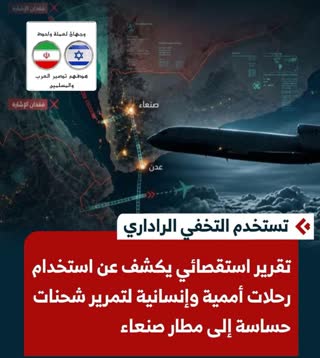
كشف تقرير استقصائي نشرته منصة «فرودويكي» (FraudWiki)، وأعده الدكتور عبدالقادر الخراز، عن ما وصفها بـ«اختراقات معقدة» للمجال الجوي اليمني، قال إنها استُخدمت لتمرير رحلات وشحنات حساسة إلى مطار صنعاء الخاضع لسيطرة مليشيا الحوثي، بالتزامن مع تحركات لطائرات تابعة للأمم المتحدة ومنظمة «أطباء بلا حدود».
ووفق التقرير، فإن طائرة الشحن الكينية Boeing 727-2Q9(Adv)(F)، المسجلة بالرمز 5Y-GMA، والمشغلة من شركة Safe Air الكينية، نفذت رحلة من نيروبي إلى صنعاء دون تسجيل وجهة رسمية على أنظمة التتبع خلال أجزاء من مسارها، مع إيقاف جهاز الإرسال والاستجابة (Transponder)، قبل أن توثق فرق الرصد وصولها إلى مطار صنعاء.
رحلة نيروبي – صنعاء وإخفاء الإشارة
بحسب التسلسل الزمني الوارد في التقرير، أقلعت الطائرة من نيروبي صباح 22 سبتمبر، وبعد تنفيذها مناورات داخل المجال الجوي الكيني عادت إلى المطار قبل أن تقلع مجدداً باتجاه الشمال، دون ظهور وجهة رسمية لها على أنظمة التتبع.
وفي 09:15 ظهرت إشارة الطائرة لعدة دقائق فوق المياه الإقليمية اليمنية قرب أجواء عدن، بالتزامن مع إقلاع طائرة أممية تحمل الرمز UNO132H من جيبوتي، قبل أن تختفي الإشارة مجدداً عند 09:17 وتستمر حتى 09:35، وفق التقرير.
وقال التقرير إن الطائرة واصلت توغلها باتجاه صنعاء بصورة غير ظاهرة على أنظمة التتبع، بينما ظهرت في المنطقة ذاتها طائرة الأمم المتحدة UNO132H وطائرة «أطباء بلا حدود» بالرمز 3BNBZ.
وعند 09:53، قال التقرير إن فرق الرصد الميداني وثقت عبر التصوير وصول الطائرة الكينية وهبوطها في مطار صنعاء، قبل أن تقلع مجدداً عند 10:35 متجهة جنوباً مع استمرار إخفاء إشارتها الرادارية.
وأضاف أنها ظهرت مجدداً عند 11:10 فوق المياه الإقليمية قرب عدن، في النقطة ذاتها التي اختفت فيها صباحاً، قبل أن تتجه نحو جيبوتي، ثم أغلقت إشارتها عند 11:18 أثناء تحليقها على ارتفاع منخفض، وفق بيانات التتبع التي أوردها التقرير.
وبحسب التقرير، ظهرت الإشارة مجدداً عند 12:35 بعد مغادرة مطار جيبوتي، قبل أن تُغلق لاحقاً خلال رحلتها إلى نيروبي، حيث عادت الطائرة إلى كينيا.
تحركات موازية لطائرات أممية وإنسانية
وربط التقرير هذه الرحلة بتحركات طائرتين أخريين، إحداهما تابعة لـ«أطباء بلا حدود» وتحمل الرمز 3BNBZ، والأخرى أممية تحمل الرمز UNO132H.
وقال إن طائرة «أطباء بلا حدود» أقلعت من جيبوتي دون وجهة محددة، ولم تهبط في عدن خلال رحلتها إلى صنعاء، قبل أن تتجه مباشرة إلى مطار صنعاء، مشيراً إلى أن الرحلة، بحسب التقرير، لم تكن مدرجة في جدول الرحلات الأممية المعتمد لشهر سبتمبر 2026.
وأضاف أنها هبطت في عدن لمدة نحو 40 دقيقة أثناء رحلة العودة من صنعاء، قبل أن تغادر باتجاه جيبوتي عند 12:35.
أما الطائرة الأممية UNO132H، فقال التقرير إنها انحرفت عن مسارها المجدول (جيبوتي – عدن – الرياض – سيئون – عدن – جيبوتي)، إذ اتجهت بعد هبوطها في عدن إلى المكلا، قبل أن تعود إلى عدن ثم تغادر باتجاه جيبوتي.
وبحسب التقرير، شهد مطار صنعاء في ذلك اليوم وصول طائرتين؛ إحداهما طائرة شحن كبيرة والأخرى متوسطة الحجم.
التقرير يرجح طبيعة حساسة للشحنة
وفي تحليله للمعطيات، رجح التقرير أن تكون الطائرة الكينية قد حملت شحنة ذات طبيعة حساسة، عسكرية أو تقنية، مستنداً إلى ما وصفه بالمسار المباشر والمتخفي من نيروبي إلى صنعاء وتجاوز نقاط التفتيش.
كما اعتبر أن توقف الطائرة في جيبوتي خلال رحلة العودة قد يكون إجراءً تمويهياً يوحي بخضوع الرحلة للإجراءات الاعتيادية، بعد إتمام عملية الوصول والإفراغ في صنعاء.
وربط التقرير بين تزامن تحركات الطائرة الكينية وطائرتي الأمم المتحدة و«أطباء بلا حدود»، معتبراً أن كثافة الحركة الجوية خلال الفترة الممتدة تقريباً بين 09:15 و09:32 يمكن أن تكون قد ساهمت في تشتيت الرصد الجوي والتغطية على حركة الطائرة الكينية.
«القناة الجوية الموازية» وحوادث سابقة
وربط التقرير واقعة 22 سبتمبر بما وصفه بسلسلة سابقة من الخروقات الجوية التي يقول إنه وثقها خلال أغسطس وسبتمبر 2026، مشيراً إلى نمط متكرر من إطفاء أجهزة Transponder فوق خليج عدن وقبل دخول أجواء صنعاء.
كما تحدث عن وجود، «جدولين» للرحلات الإنسانية؛ أحدهما معلن للجهات الرسمية والإعلام، والآخر عملياتي مغلق، زاعماً أن بعض الرحلات تنفذ ميدانياً مسارات لا تتطابق مع الجداول المعلنة.
ويقول التقرير إن استمرار وصول رحلات إلى مطار صنعاء بصورة مباشرة ومن دون المرور بإجراءات التفتيش المعتادة يثير تساؤلات بشأن مدى الالتزام بآليات الرقابة وقرارات حظر نقل الأسلحة إلى اليمن.
ربط الطائرة بحادثة 13 يوليو
وأشار التقرير إلى أن الطائرة الكينية نفسها 5Y-GMA سبق أن رُصدت في 13 يوليو 2026 خلال واقعة مرتبطة بدخول الطائرة الإيرانية المشبوهة إلى الأجواء اليمنية.
ووفق التقرير، وصلت الطائرة الكينية التابعة لـ«Safe Air» إلى مطار صنعاء عند 09:10 وغادرته عند 10:07، قبل هبوط طائرة تابعة للجنة الدولية للصليب الأحمر في المطار، حيث أعلنت مليشيا الحوثي لاحقاً «حجزها» في صنعاء.
ويرى التقرير أن تزامن وجود الطائرتين ربما وفر غطاءً لوجستياً وضغطاً ميدانياً في ظل التحذيرات التي كانت قائمة آنذاك بشأن حركة الطيران، بينما حاولت الطائرة الإيرانية، دخول الأجواء اليمنية والهبوط في صنعاء قبل أن تغير مسارها وتهبط في مطار الحديدة.
ويخلص معد التقرير إلى أن تكرار استخدام الطائرة الكينية ذاتها في واقعة 13 يوليو وواقعة 22 سبتمبر يثير، من وجهة نظره، شبهة وجود نمط منسق، ويصفها بأنها قد تؤدي دوراً لوجستياً في إنشاء ما سماه «قناة جوية موازية» تستخدم التخفي الراداري أو كثافة الرحلات الإنسانية لتسهيل تحركات جوية مرتبطة بمليشيا الحوثي.
مطالب بفتح تحقيق
وطالب التقرير الحكومة اليمنية والتحالف والجهات الدولية المعنية بالملاحة الجوية بفتح تحقيق في مسار الطائرة الكينية، ومراجعة بيانات الرصد الراداري والتسجيلات المصورة التي قال إنها توثق هبوطها في مطار صنعاء.
كما دعا إلى الاستفسار رسمياً من الجهات المعنية بالعمليات الإنسانية عن أسباب عدم هبوط طائرة «أطباء بلا حدود» 3BNBZ في عدن خلال رحلتها إلى صنعاء، وعن عدم إدراج الرحلة في جدول الرحلات المعتمد لشهر سبتمبر.
ودعا كذلك إلى تحديث أرشيف ما سماه «ملف القناة الجوية الموازية» وإضافة تسجيلات الهبوط والبيانات الرادارية الخاصة برحلة 22 سبتمبر إلى ملفه الاستقصائي تمهيداً لإصدار تقارير لاحقة.